Maple Explorers · Pacific Adventure
Chapter 13 field guide
Every layer keeps a clue.
A family guide to Drumheller’s badlands, fossil formation, careful field science, and the ancient world beneath our feet.
Bones beneath our feet
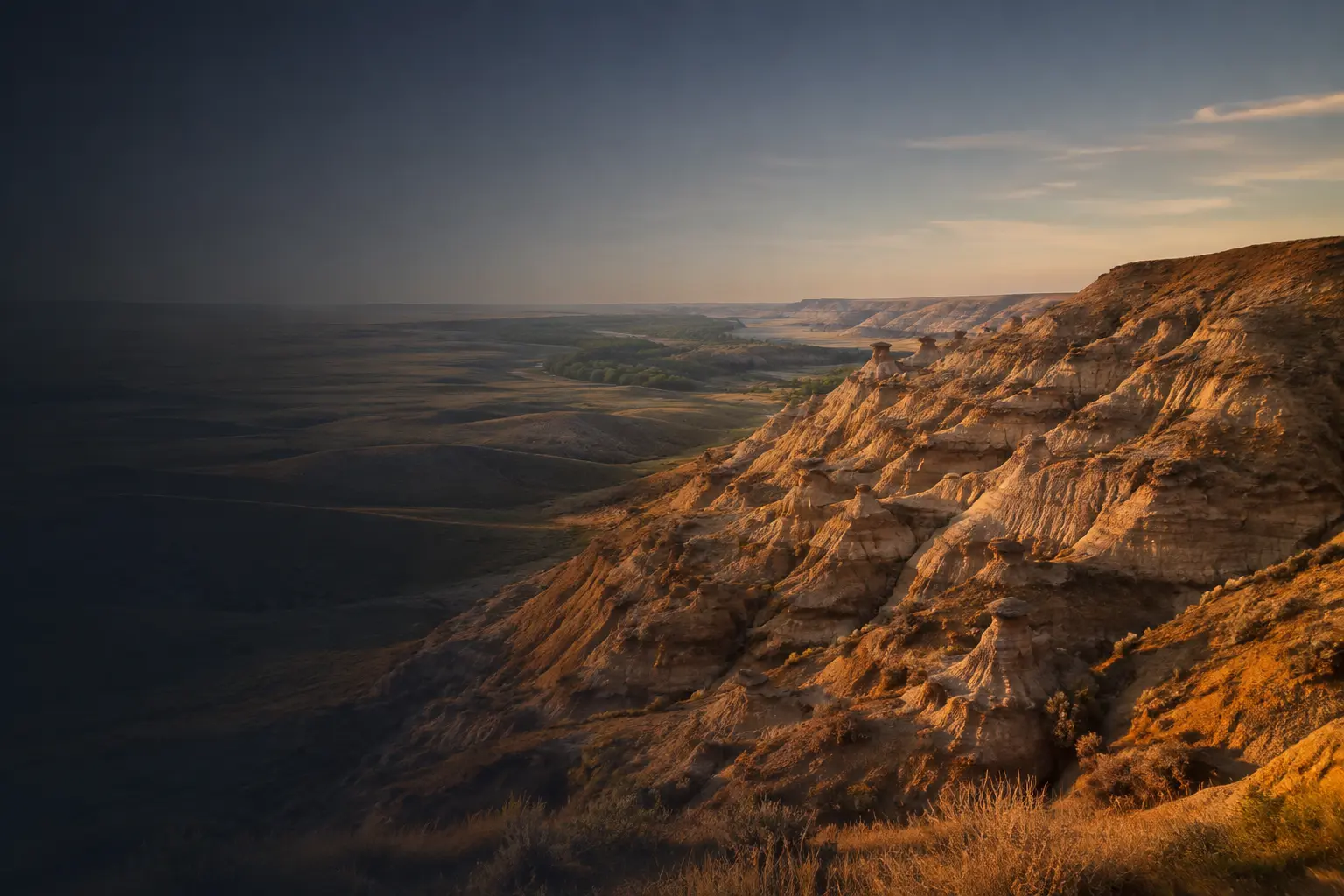
The badlands are a library written in rock.
In Chapter 13, the Maple Explorers follow striped hills, a leaf-shaped clue, and a careful palaeontologist from a trail to the museum.
The real landscape carries the same lesson. Ancient river mud buried rare remains; minerals and sediment preserved some of them; much later, erosion opened those layers to view. A fossil matters most when its rock, position, and place remain connected to it.
An evergreen field rhythm
Four habits for any badlands visit
No fixed route, timetable, or seasonal promise—just a durable sequence that adapts to current access and your family.
Choose a place meant for visitors
Use an open public trail, museum, or viewpoint, and confirm current access with the official site before setting out.
Read the layers from the path
Notice bands, slopes, textures, and shapes without climbing fragile formations or crossing barriers.
Record clues, not souvenirs
If something looks fossil-like, photograph it, mark the location, and leave it exactly where it is.
Connect the clues indoors
At the museum, compare your observations with prepared fossils, ancient habitats, and the tools scientists use.

Barrett’s workshop
Small tools protect big clues.
Palaeontologists work slowly because a fossil’s position is evidence—not empty space around the bone.
-
01
Divide the site
A string grid gives every exposed piece an exact place on the field map.
-
02
Record before moving
Notes, photographs, scales, and rock layers preserve the story around the specimen.
-
03
Prepare with patience
Museum technicians remove surrounding rock carefully so fossils can be researched and displayed.

If a fossil catches your eye
Protect the clue before the souvenir.
Capture visible features and include a familiar object for scale without moving the find.
Record permanent landmarks or GPS. The place can matter as much as the fossil.
Do not excavate buried material. Protected-area fossils must remain where they are.
Hazel’s science notes
How a rare remain becomes rock history
Fossilization is not one instant. It is a chain of uncommon conditions—burial, changing sediment, mineral-rich water, and a much later return to the surface.

Mud or sand covers a rare remain quickly.
More sediment builds above it over time.
Groundwater helps preserve or replace material.
Erosion exposes the fossil-bearing rock again.
Burial must happen before decay, scavenging, weather, or water removes the remains. A fossil is the exceptional survivor, not the ordinary outcome.
Parks Canada: burial, minerals, and erosion ↗Read more than the bone
Context turns a find into evidence.
A loose object can be interesting. A mapped fossil inside a known layer can help reconstruct a place, a time, and the lives around it.
Explore the museum’s collectionsWhen?
Its position within sedimentary strata helps place a fossil in the sequence of local rock history.
Where?
A precise site connects the find to landforms, ancient river channels, and other discoveries.
With what?
Plants, shells, pollen, teeth, and nearby bones can reveal a larger community.
What happened?
Breaks, orientation, sediment, and preservation carry clues about burial and change after death.

Aspen’s nature journal
Today’s dry hills hold a wet ancient world.
About 75 million years ago, eastern Alberta was a low coastal plain beside a shallow sea—not the dry, eroded landscape we see now.
Rivers and muddy floodplains moved sediment and sometimes buried remains quickly enough to preserve them.
Conifers, ferns, and other vegetation supported a rich food web and left their own fossil clues.
Much later, water cut through the older rock, forming coulees and hoodoos and exposing fossil-bearing layers.
Family questions
Simple answers for a careful fossil adventure
Can children collect fossils in the Drumheller badlands? +
Not in provincial or national parks, protected areas, or Midland Provincial Park. Alberta’s rules vary by land status and fossil type, so the durable family rule is to observe, photograph, leave finds in place, and follow the Royal Tyrrell Museum’s current guidance.
What should we do if we think we found a fossil? +
Photograph visible features, record the location with permanent landmarks or GPS, leave buried material untouched, and report a promising find to the Royal Tyrrell Museum. Its official reporting page explains what information to include.
Why is a fossil’s exact location important? +
The surrounding rock layer, position, and nearby remains give scientists context. That context can help identify the fossil’s age, ancient environment, and relationship to other finds.
How does a bone become a fossil? +
A common path begins with rapid burial in sediment. More layers accumulate, groundwater carries minerals through the rock, and the remains are preserved or replaced. Much later, erosion may expose the fossil again. Most living things never fossilize.
Did today’s dry badlands always look this way? +
No. Fossil-bearing rocks record much warmer, wetter Late Cretaceous environments. Today’s coulees and hoodoos formed as erosion cut into those older layers and revealed their clues.
What is a useful evergreen field kit for families? +
Sturdy closed-toe shoes, sun protection, layers for changing weather, water, binoculars, a camera, and a plain notebook support careful observation. Check the official visitor page for current conditions before every outing.

Read the adventure
Bones Beneath Our Feet
Drumheller · Pacific Adventure Story 13
Lumi maps the route, Barrett studies the tools, Hazel reads the rock layers, and Aspen imagines the ancient forest. Read the complete illustrated chapter together.
11 illustrated pages · family read-aloud
Research trail