Explore Canada · Lake Louise
How glaciers shaped Lake Louise
Follow the clues from moving ice to turquoise water, then plan a safe and memorable family day in the Canadian Rockies.
A child-friendly companion to Valley of Ice, Chapter 9 of the Maple Explorers' Pacific Adventure.

A jewel in the Rockies
A real place full of story-sized clues
Lake Louise sits about 55 kilometres west of the town of Banff. Bright water, hanging glaciers and mountain walls make the forces that shaped this valley unusually easy for young explorers to see.
Banff National Park is within the present-day territories of Treaty 6, 7 and 8 First Nations and the Métis Homeland. Indigenous Peoples have used these lands and waters for sustenance, ceremony, trade and travel for millennia.
Learn about Indigenous connectionsFamily road-trip map
From turquoise lake to living ice
Use Lake Louise as the story starting point, then follow the Icefields Parkway north to Bow Lake and the Columbia Icefield. This is an illustrated overview—not a navigation map.

- 1Lake LouiseBegin with the lakeshore story clues
- 2Bow LakePicnic beside the headwaters of the Bow
- 3Icefield CentreStart with exhibits and current advice
- 4Forefield TrailWalk through terrain uncovered by retreating ice
- 5Toe TrailSee the glacier edge from the marked route

Choose your trail
Little legs or big explorers?
The lakeshore and Plain of Six Glaciers begin in the same place, but they are very different family days.
Trail figures are from Parks Canada. Always check live conditions and closures before choosing.
Ready for the Rockies
Pack for a mountain day, not a city stroll
Weather changes quickly, wildlife lives here year-round and help is not always immediate. A little preparation makes the day calmer for adults and more fun for children.
Check trail conditionsFamily trail checklist
- ✓Reserved shuttle tickets and a park pass
- ✓Warm layers and rain shells for everyone
- ✓Water, lunch and extra high-energy snacks
- ✓Bear spray carried accessibly - and an adult who knows how to use it
- ✓First-aid kit, sun protection and a turnaround time
- ✓A plan to stay together and leave wildlife alone
2026 access planner
Reserve first. Relax later.
Lake Louise is one of Canada's busiest destinations. Transit is the simplest way to remove parking uncertainty from a family day.
Book the shuttle
Parks Canada releases advance seats and more on a rolling 48-hour window.
Check in correctly
Regular shuttles leave from the Park and Ride at the Lake Louise ski area.
Leave return time
Know the last shuttle and turn around early. Missed connections are your responsibility.
Verify details
Dates, fees and operating rules change. Recheck Parks Canada close to your trip.

A second field lab
Choose the forefield—not the glacier
Two marked trails near the Icefield Centre let families read the glacier's story while staying safely off unstable ice.
Forefield Trail
3.6 km return · 1–2 hours · moderate. Cross rocky terrain uncovered by the glacier's retreat since the 1800s.
Toe of the Glacier
1.8 km return · about 1 hour · 60 m gain. See scratched limestone and the glacier edge from the marked route.
Glacier field lab
Why does Lake Louise look turquoise?
The answer begins high above the lake, where a moving river of ice slowly grinds against the mountains.
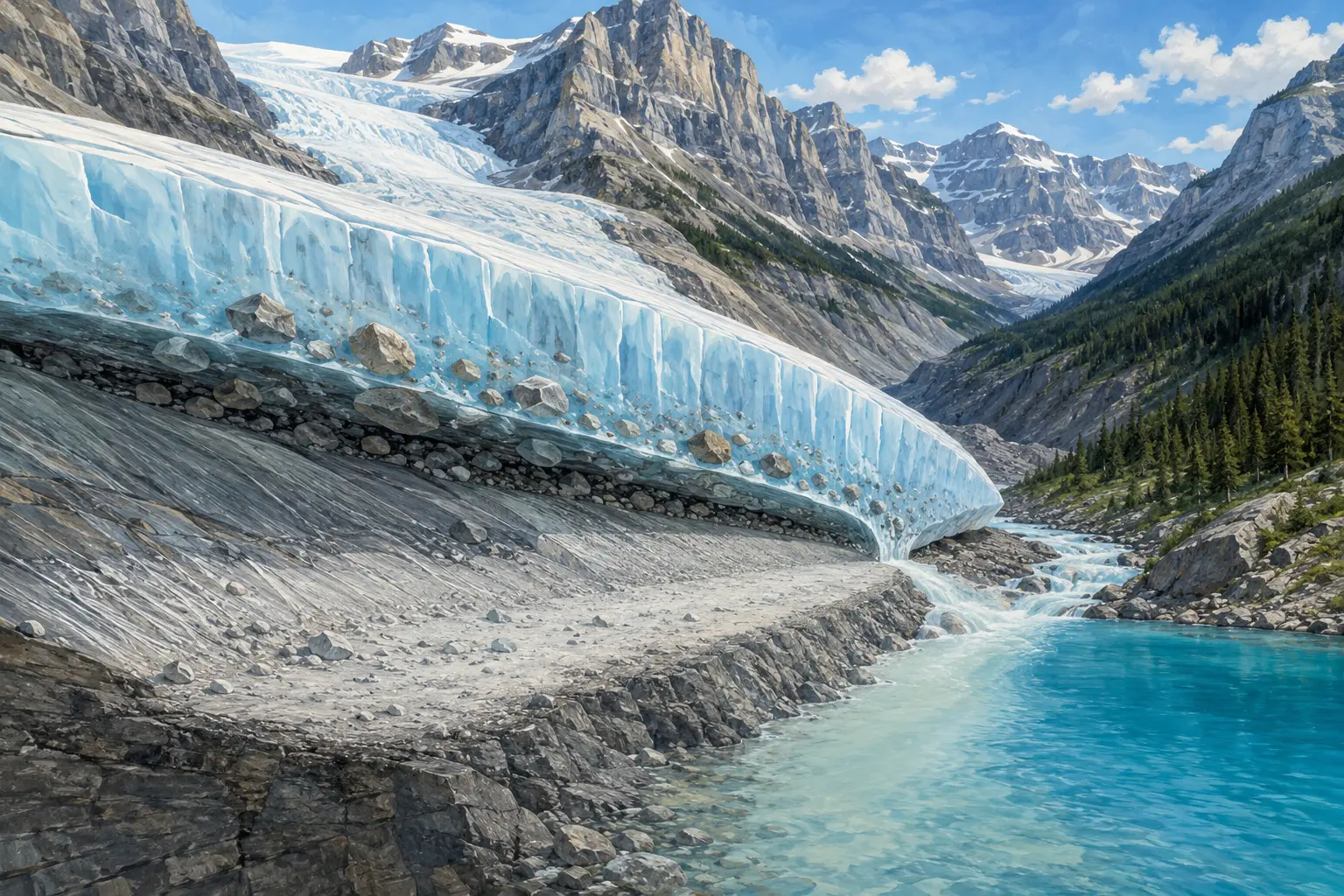
Rock flour + sunlight
Glacier ice drags stones across bedrock like giant, slow sandpaper. The powder is so fine that it floats in meltwater. When those grains reach the lake, they scatter light and help the water appear blue-green.
The U.S. Geological Survey identifies glacial rock flour carried by meltwater as the source of Lake Louise's turquoise colour.
Snow becomes ice
Mountain snow is pressed into dense glacier ice over many years.
The glacier moves
Gravity pulls the heavy ice slowly downhill, even when it looks still.
Rock becomes flour
Stones under the ice grind bedrock into particles finer than sand.
The lake glows
Meltwater carries those grains into the lake, where they scatter blue-green light.
Read the landscape
Four clues children can spot
Turn the walk into a gentle science hunt. The best tools are careful eyes, curious questions and staying on the marked path.
A U-shaped valley
Glaciers widen mountain valleys, leaving broad floors and steep sides.
Milky meltwater
Cloudy streams carry fine glacial sediment toward the lake.
Gentle switchbacks
Back-and-forth turns make steep slopes easier and protect fragile plants.
Fast-blooming flowers
Alpine plants use the short mountain summer quickly. Look, but never pick.
Family questions
Before you go
Quick answers grounded in current official guidance.
Is Lake Louise a good place to visit with children?
Yes. Parks Canada rates the Lake Louise Lakeshore Trail as easy. It is 2.3 km one way; families should allow extra time beyond the official one-hour return estimate for snacks, photos and discovery stops.
Why is Lake Louise turquoise?
Glaciers grind rock into very fine sediment called rock flour. Meltwater carries it into the lake, where suspended grains scatter light and help create the famous blue-green colour.
Can families drive directly to Lake Louise?
Lake Louise has limited paid parking that commonly fills very early. Parks Canada recommends reserving a shuttle or using public transit. Moraine Lake Road is closed to personal vehicles year-round.
When is the best season for a family hike?
Prime hiking season is generally July through mid-September. Snow can remain on higher trails into late June, and mountain weather changes quickly, so check current conditions before leaving.
Is Plain of Six Glaciers suitable for young children?
It is a much bigger outing than the lakeshore walk: 5.8 km one way, with a four-hour official return estimate. Treat it as an option for prepared families with older, experienced hikers.
Can families walk onto the Athabasca Glacier?
No. Parks Canada warns that the glacier is unstable, with hidden crevasses, hollow ice and fast, extremely cold water. Stay on marked trails and use a licensed guide or authorized tour for any on-ice experience.
 Open the story
Continue the adventure
Read Valley of Ice
Lumi, Aspen, Hazel and Barrett follow a cloudy stream, discover switchbacks and learn how a glacier helped colour Lake Louise. The illustrated chapter turns the real science on this page into a warm story for young readers.
- Designed for children ages 5-9
- Glacier science through story clues
- Gentle trail stewardship message
Research sources
Travel details reviewed August 6, 2026. Always confirm current conditions before your trip.