Maple Explorers · Pacific Adventure
Chapter 12 field guide
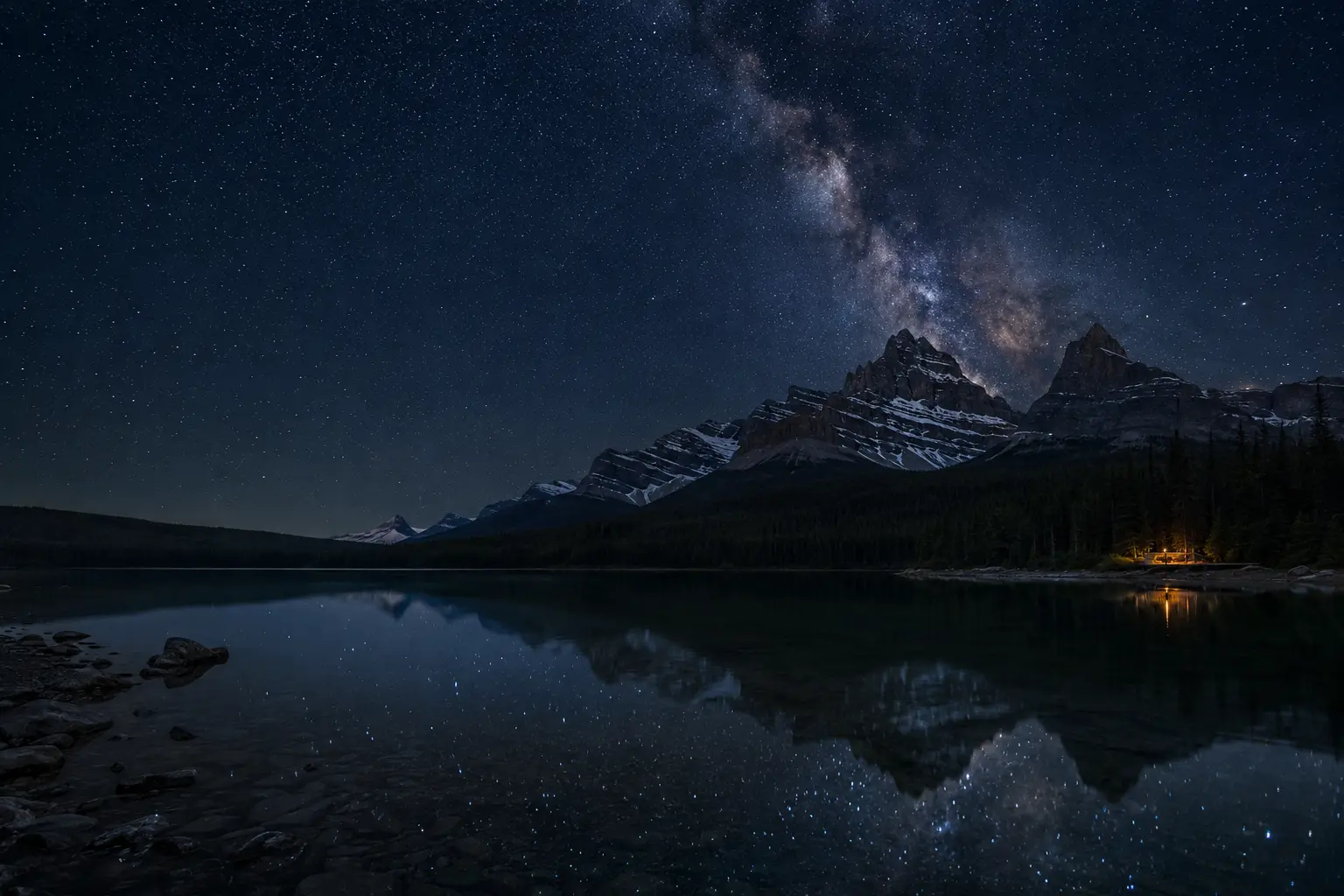
Look up without turning the night on.
A family guide to Jasper’s dark sky, bright stars, simple telescope science, and the wildlife that needs darkness too.
Beneath Jasper’s stars
Darkness is not empty. It is habitat.
In Chapter 12, a fading lantern reveals what bright light can hide: a sky full of distant suns and a landscape still busy with bats, owls, and other night travellers.
That story idea reflects real conservation. Parks Canada says light pollution can interrupt natural processes, while the Royal Astronomical Society of Canada defines a dark-sky preserve as a place where artificial lighting is limited and controlled. The result is not just a clearer view upward—it is a healthier night all around us.
A flexible family rhythm
Four moves for any clear night
No fixed tour, timetable, or viewpoint—just a durable sequence that adapts to current conditions and your family.
Prepare before the light fades
Check Parks Canada’s current conditions, choose a public place that is open, and pack warm layers, a simple sky guide, and one dim red light.
Arrive as one little team
Keep children close, learn the route back while it is still easy to see, and pick stable ground away from traffic and shore edges.
Let the sky come to you
Pause bright screens and white lights. Begin with your eyes, then try binoculars or a telescope only if they add to the wonder.
Leave the night as you found it
Speak softly, pack out every item, never approach wildlife, and return together by the same confirmed route.

Protect the view
Use only the light you need.
Good night vision and good habitat care begin with the same habit: keep light low, warm, shielded, and brief.
-
01
Dim before you arrive
Lower screen brightness and prepare gear before stepping into the dark.
-
02
Point light down
Use a shielded red light for hands and footing, never as a beam across the sky or landscape.
-
03
Watch without chasing
Never call, follow, feed, spotlight, or crowd nocturnal animals.

Before heading out
Make safety current. Keep this page timeless.
Check official conditions, weather, notices, and closures before every outing.
Use maintained public areas, keep children close, and know the return route.
Never approach wildlife. Back away if an animal changes its behaviour or path.
Barrett’s workshop
A telescope is a careful light collector.
It does not bring a star closer. A curved lens or mirror gathers faint light and focuses it into an image your eye can inspect.

A wide objective catches more faint light than an eye alone.
The curved lens bends the rays toward one clear image.
The eyepiece helps your eye inspect that focused light.
A sturdy tripod and slow focus adjustments keep the view from wobbling. The best first view is often a bright, easy target—not the faintest object in the sky.
NASA Space Place: how telescopes work ↗Hazel’s science notes
Why enormous stars look tiny
Distance changes what we see. Stars are immense, but their light crosses so much space that they arrive as small points in our sky.
Explore NASA’s star scienceOur Sun
The daylight above us comes from a star: a hot, glowing ball of gas close enough to fill our days with light.
Tiny to our eyes
Most night stars are so far away that even enormous ones look like pinpricks rather than disks.
Constellations
People connect stars into memorable pictures. The stars in a pattern may sit at very different distances.
The Milky Way
Its pale band is our inside view of a galaxy containing the Sun and more than 100 billion other stars.

Aspen’s nature journal
The quiet shift is still full of life.
Owls, bats, insects, and other nocturnal species do not need an audience. They need habitat—and our respectful distance.
Keen hearing, low-light vision, and silent flight help them move through darkness.
Many species use returning echoes to navigate and find flying insects.
Observe from afar, keep food packed away, and never use light to follow an animal.
Family questions
Simple answers for a night under the stars
Do children need a telescope to enjoy Jasper’s night sky? +
No. Eyes are the best first tool. Children can notice bright stars, the Moon, star colours, silhouettes, and patterns before adding binoculars or a telescope.
Why use a red light at night? +
A dim, shielded red light can illuminate hands or the ground without creating the broad glare of a bright white beam. Keep it pointed down and use only as much light as safety requires.
What does a dark-sky preserve protect? +
It limits and carefully controls artificial light, supports public education, protects the natural night environment, and keeps the sky more visible for people.
Where should a family stargaze in Jasper? +
Choose a maintained public area that Parks Canada currently confirms is open and appropriate. Conditions and access can change, so this page intentionally does not prescribe a fixed viewpoint or route.
What should we do if wildlife appears? +
Do not approach. Keep the family together, give the animal space, and back away if needed. Parks Canada’s wildlife guidance remains the authority for current rules and recommended distances.
How does a telescope make faint objects easier to see? +
Its mirror or lens gathers light across a wider opening than an eye and focuses that light into an image. A steady tripod helps keep that image from wobbling.

Read the adventure
The Sky Above Us
Jasper Dark Sky Preserve · Pacific Adventure Story 12
Lumi finds the route, Barrett shields the lantern, Hazel follows the stars, and Aspen listens for the animals moving after dark. Read the complete illustrated chapter together.
11 illustrated pages · family read-aloud
Research trail