Tofino · Vancouver Island
Read the
moving ocean.
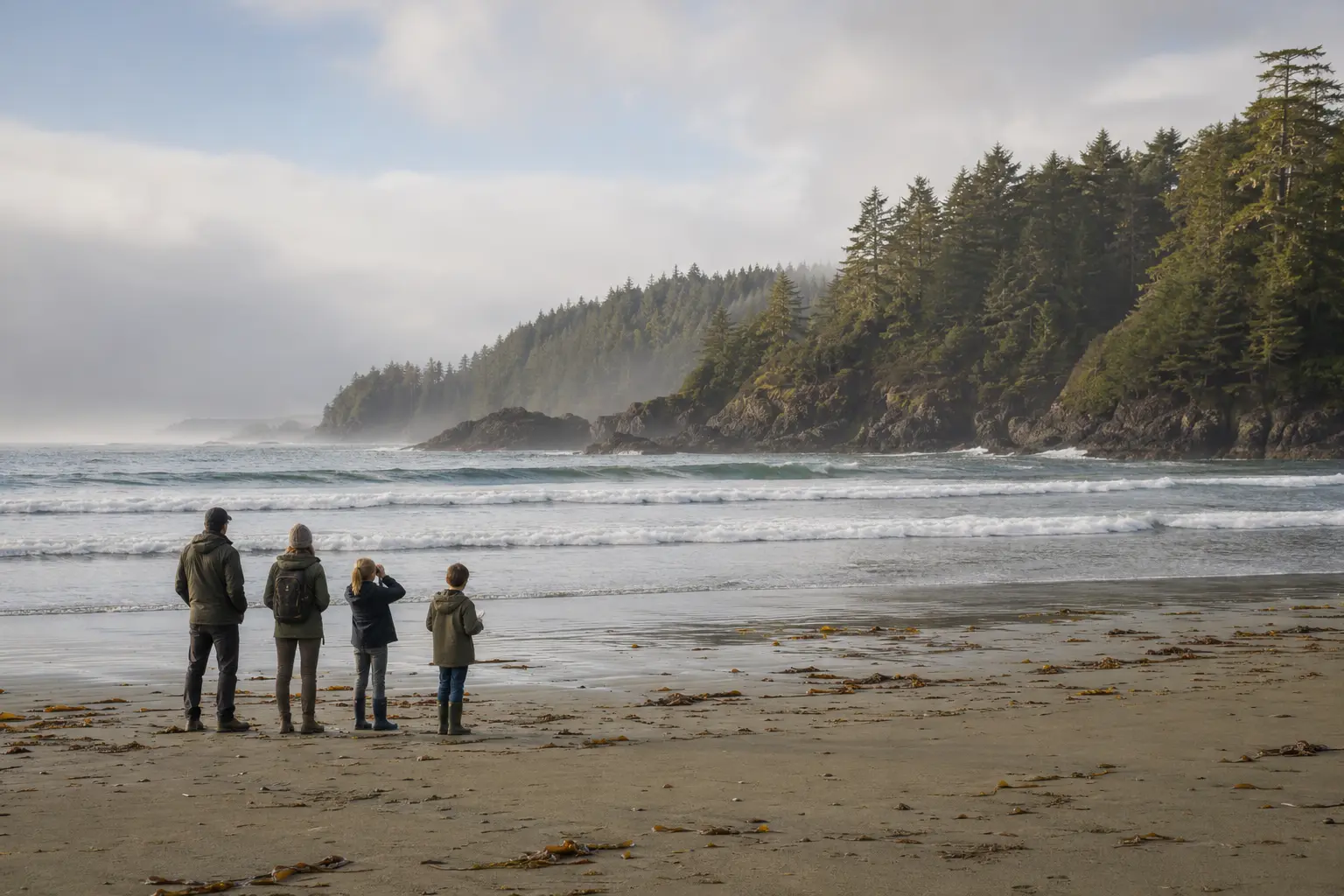
At Tofino, waves carry energy toward shore while currents move water along and away from it. Follow foam, kelp, and a small model board to see the difference.
PLACETofino, Vancouver Island
COASTPacific surf and rocky headlands
ECOSYSTEMKelp forest
BIG IDEAWaves and currents differ
Read the water
The ocean can move in more than one direction.
A wave is a travelling pattern of energy that makes water rise and fall as it approaches shore. A current is the sustained movement of water from place to place. Foam, floating kelp, and the direction of breaking waves can reveal both—but shore conditions demand distance and care.
Map the moving coast
One peninsula points into the Pacific.
Tofino sits at the tip of the Esowista Peninsula on Vancouver Island. The detailed shoreline and mapped Highway 4 corridor keep the village visibly connected to the island while preserving the beaches’ real north-to-south order.

Start in TofinoThe village sits at the northwestern tip of the Esowista Peninsula on Vancouver Island, with Tonquin Beach close by.
Move south along the coastChesterman Beach comes before Cox Bay, followed by the Long Beach area farther south.
Observe from dry landA correct map cannot make surf safe; use established access and current coastal guidance.
 WATCH · COMPARE · STAY BACK
Family field habits
Study the water from shore.
The Pacific is powerful and conditions can change quickly. Good observation does not require entering the water.
-
01
Choose a dry viewpointWatch from a stable upper-shore position where waves cannot unexpectedly surround the group.
-
02
Track harmless cluesFollow foam lines, bubbles, and drifting kelp visually; never send a child or object into active surf.
-
03
Know the differenceBreaking waves are not the same as currents, and smooth-looking water can still be hazardous.
Use the official park or government page for current access, conditions, and safety information.
Motion leaves clues
Four ways to read the sea
No single splash explains the ocean. Repeated observations reveal how energy, water, shape, and direction interact.
Wave sets
Groups of crests show energy arriving toward shore in repeating patterns.
Drift
Foam and floating kelp can reveal water moving sideways or away.
Board shape
A broad hull displaces water and can make a model float more steadily.
Fin direction
A fin resists sideways slip and helps keep a board aligned as water moves past.
Test a small model
Good design works with water.
A simple model board turns invisible forces into visible motion. Controlled tests in calm water can compare one change at a time without entering surf.
- Shape A wide, smooth base spreads weight and displaces water.
- Balance Centered mass helps the model sit level instead of tipping.
- Guide A small fin increases directional stability.
- Retrieve A shore-held line keeps the test controlled and repeatable.

Below the surface
A kelp forest is a living structure.
Kelp creates food, shelter, nursery space, and three-dimensional habitat. Sea urchins graze kelp; sea otters eat urchins and other invertebrates, helping kelp habitats flourish.

Powers kelp growth.
Builds underwater habitat.
Graze kelp tissue.
Feed on grazing invertebrates.

A keystone connection
One predator can
reshape a forest.
Sea otters eat urchins, crabs, clams, and other invertebrates. By reducing grazing pressure from urchins, they can help kelp forests persist and support more habitat.
The kelp forest story is a web, not a chain.
Wild otters need space. Watch quietly from a distance and let natural feeding, resting, and travel continue without interruption.

Continue the Pacific Adventure
Story 3
Riding the Waves
Join Lumi, Aspen, Hazel, and Barrett in Tofino as foam, currents, a model surfboard, sea otters, and a kelp forest turn the moving ocean into an outdoor science lab.
Opens the chapter page on the main Maple Explorers site.
Questions from curious explorers
Field notes, answered.
01What is the difference between a wave and a current?+
A wave mainly transfers energy through water, while a current is the ongoing movement of water from one place to another.
02How can children spot a current from shore?+
From a safe dry viewpoint, watch foam, bubbles, or drifting kelp across several minutes. A steady sideways or seaward drift may reveal moving water, but it is not a signal to enter.
03Why does a wide model board float?+
A floating board pushes water aside. A broader shape can spread its load and create a stable base, while the exact result depends on size, mass, and material.
04What does a surfboard fin do?+
A fin resists sideways movement and helps a board track in a more controlled direction as water passes around it.
05How do sea otters help kelp forests?+
Sea otters eat urchins and other invertebrates. Lower grazing pressure can allow kelp forests to flourish and create habitat for many species.
06How can families explore Tofino’s coast safely?+
Observe from a stable dry location, stay well back from active surf and moving logs, never turn away from the ocean, and use current Parks Canada safety information before shoreline activities.
Research trail
Official sources behind the field guide
Core science and stewardship guidance were checked against these primary public sources. Current visit details should always be confirmed directly with the destination.